interview by Miss Goethe’s Ekphrasis / Andrea Garcia Casal
Origins of the imagery and the equine therianthrope
MG:The protagonist of your universe is this therianthropic being, a human figure with a horse’s head, hedonistic and almost totemic. Do you remember when it first appeared? Was it a casual discovery in the studio or the result of a deliberate search?
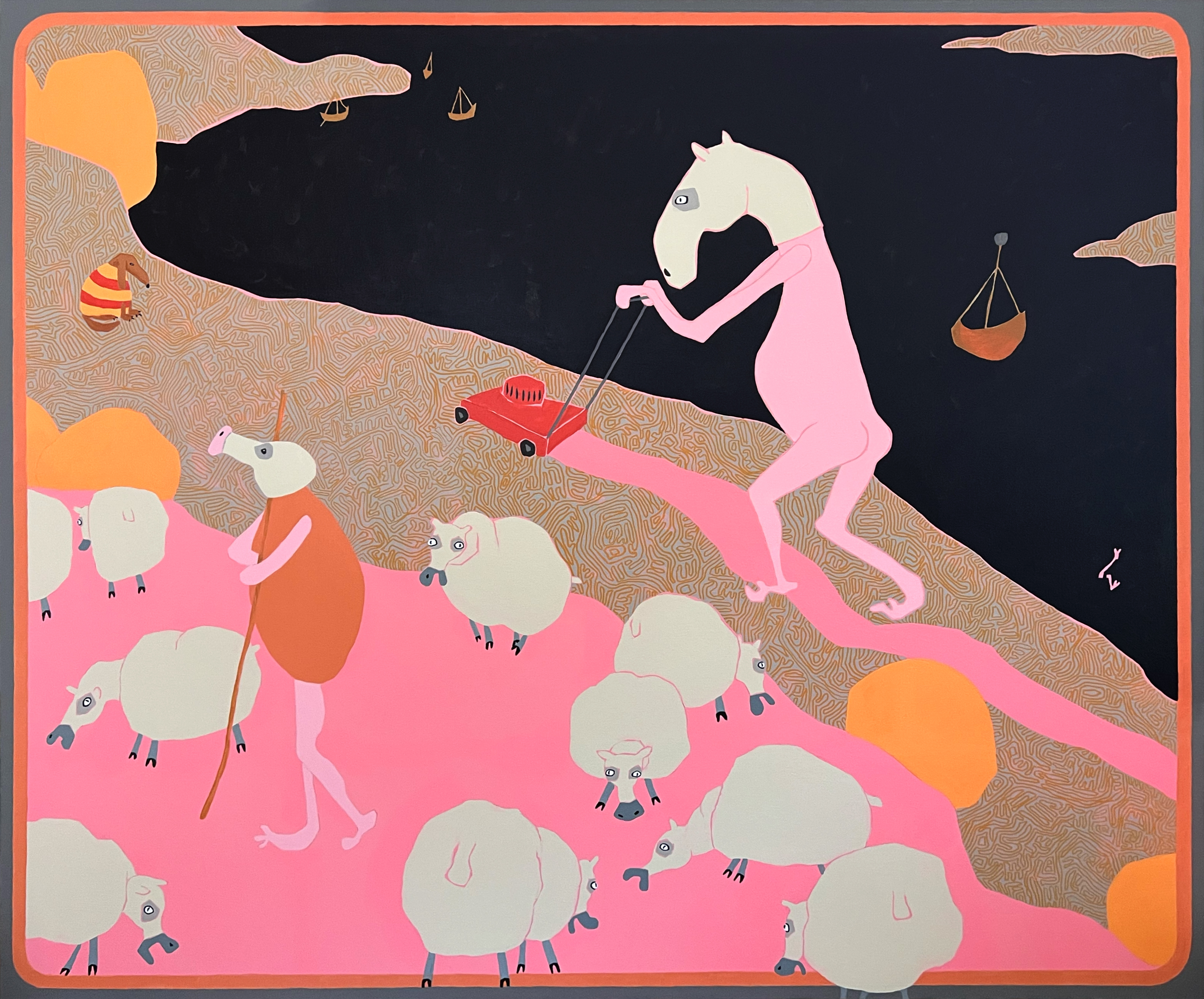
pmd: The horse figure emerged organically, and I think the first was ‘when u were promised mass disassociation but this is not what you had in mind’. I don’t recall how the painting came about, but with the title, it became a funny drug reference to doing ketamine (a horse tranquillizer, which I’ve never actually done), but then you just end up high, sitting at home in your pink coked-out suit with your dog. You were seeking escapism, but somehow you end up alone on a futon, which seemed funny/sad. This really resonated. This is when the masked/human/animal figure emerged, although it quickly lost the drug reference.
MG: What does the horse mean to you specifically: strength, vulnerability, sexuality, ridicule, sacrifice…? On what symbolic layers do you think when you paint it?
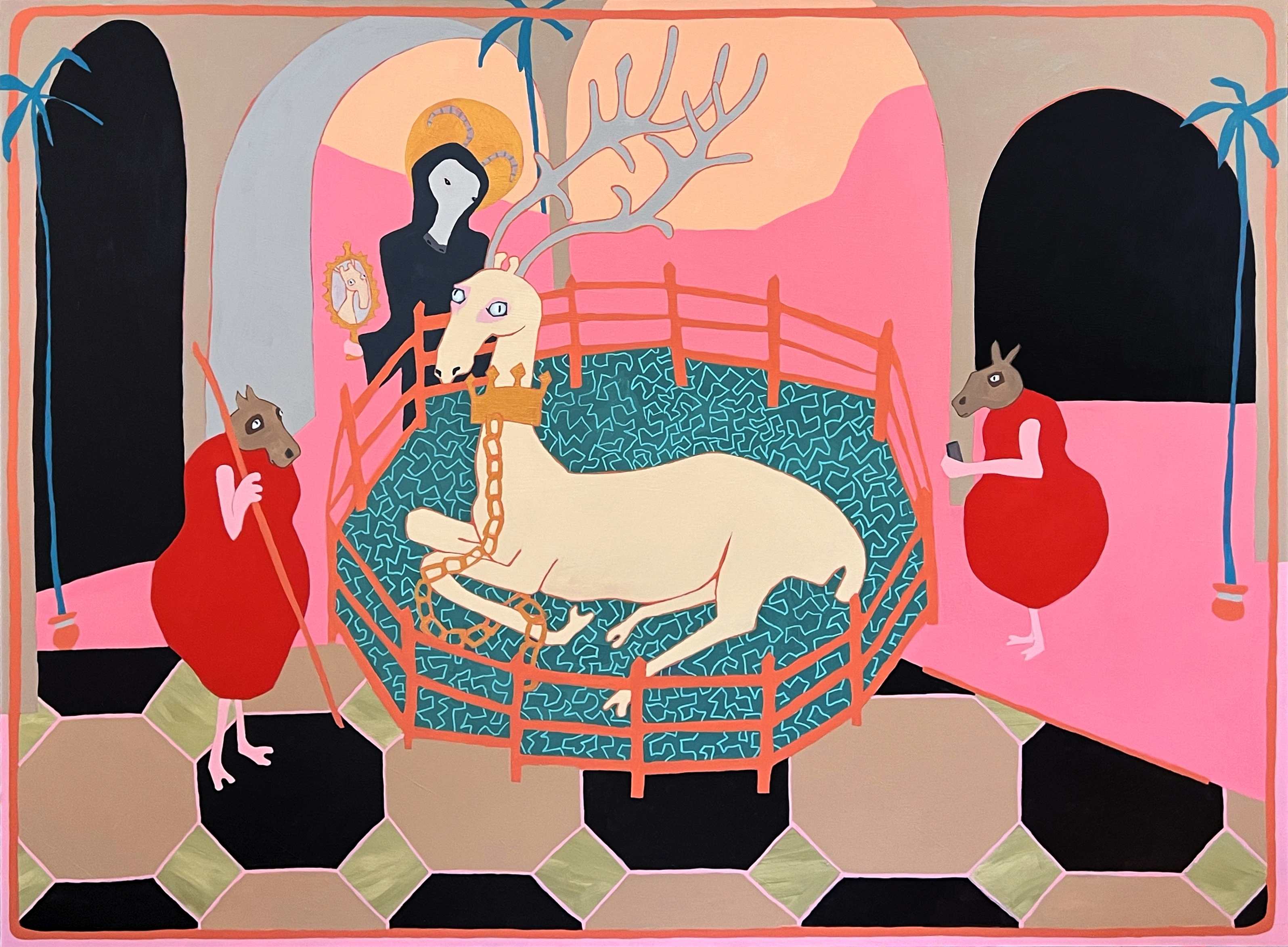
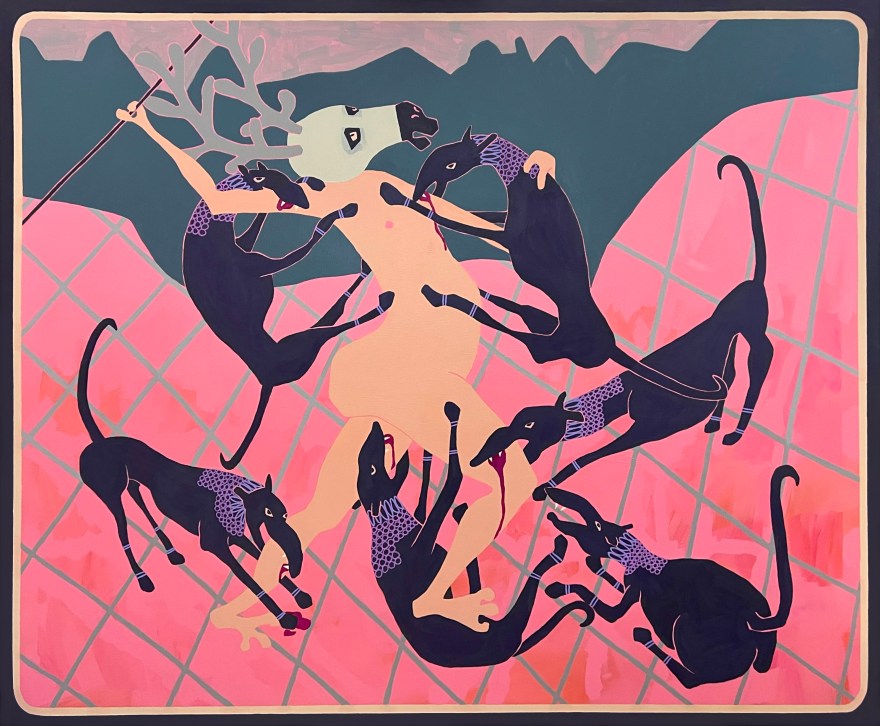
pmd: I grew up on a horse farm, & they are truly magical beings. In the paintings, the human-horse figure is desiring to be animal, although it becomes unclear if they’re wearing a mask or not, and the boundary between human/animal becomes increasingly blurry. This is where my interest in Deleuze & Guattari’s ‘becoming-animal’ comes in (although in their conception, becoming-animal is not a physical transformation). In the paintings, it is ambiguous whether the horse head is a mask, reflecting an internal yet unrealized desire for becoming-animal (still just a mask), whether it indicates a line of flight to becoming-other (the mask merges/no longer comes off), or whether the figure is a hybrid being as a result of some sort of evolution/transformation (more in the spirit of Kafka).
MG: The fact that it is a human body with an equine head creates a very particular discomfort. Are you more interested in what it has of mask, of monster, or of caricature?
pmd: I am very interested in how the horse-head figure can move mercurially between a masked being (pretending/desiring to be something-other), & a monstrous other (for transgressing human/animal boundaries). The human component of this figure does horrible things to other beings out of selfishness, ignorance, or greed, while the horse part of this being recognizes its place as part of a deeply entangled ecosystem. The delineation is never resolved.
MG: To what extent is this character an alter ego of yours, and to what extent is it a completely autonomous creature, with its own inner psychology?
pmd: It has inadvertently become an alter ego. It reflects the ways in which I feel connected to other animals, but also how as a human I embody horrible traits of selfishness, ignorance, & greed.
The dog as deuteragonist
MG: Alongside the horse, the dog appears frequently, as a faithful deuteragonist, witness or accomplice. How would you describe the dog’s function within your “cast” of characters?
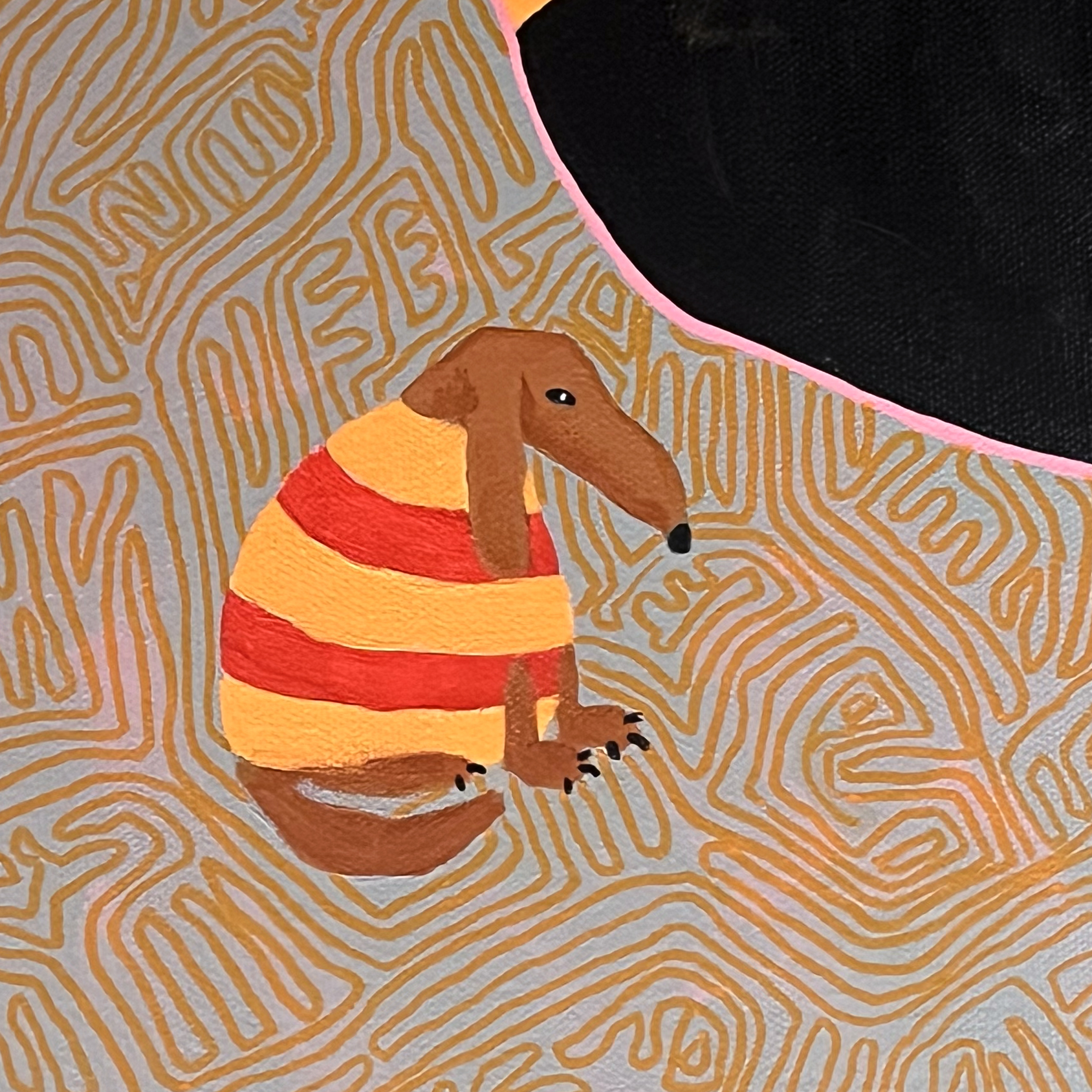
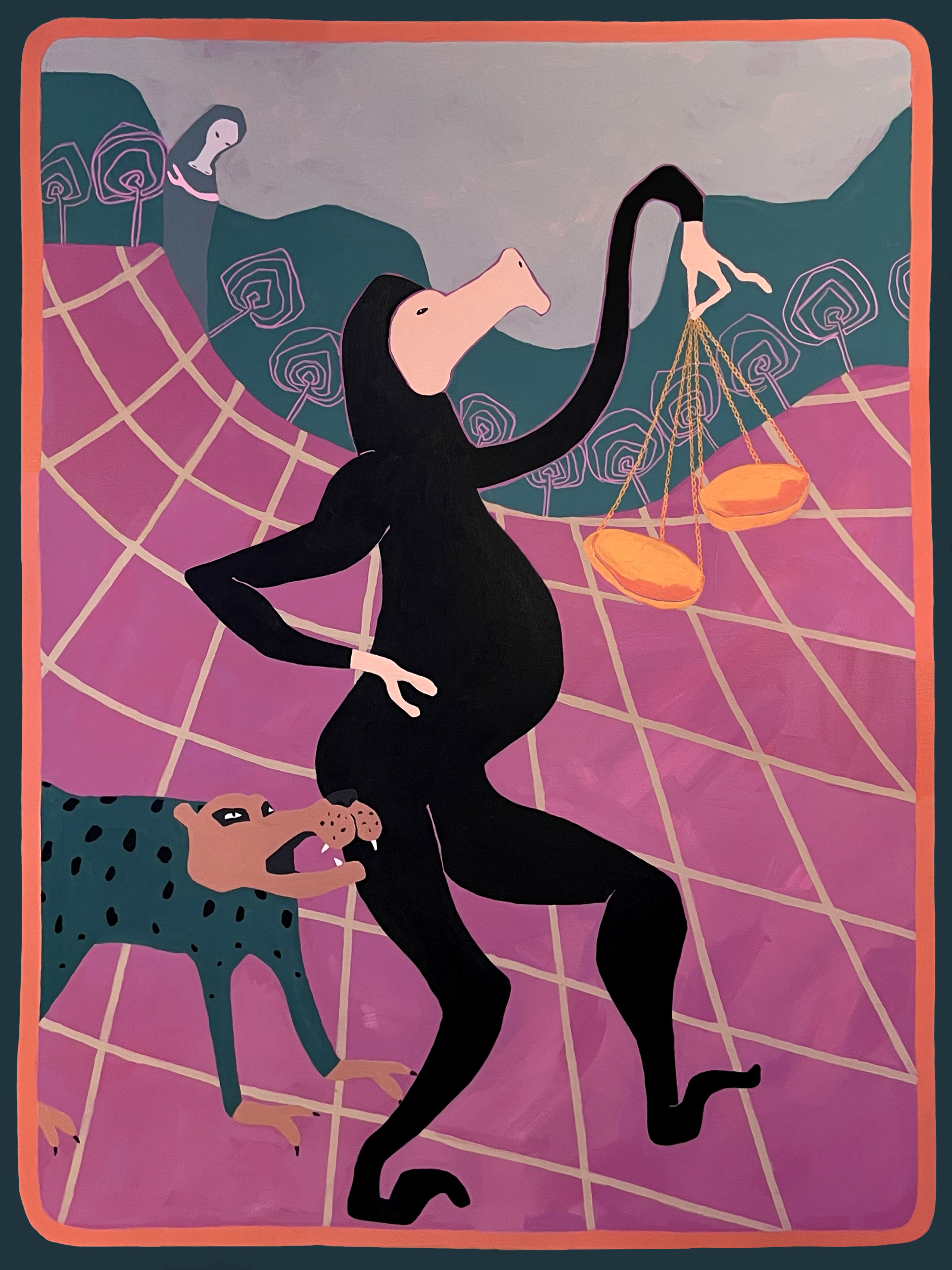
pmd: The dog is the unwilling accomplice. The things that the dog witnesses appall them on the deepest level, yet they remain bound in the role of a faithful companion, forced to wear ugly sweaters and be tied to chairs. Their scathing judgement passes almost unnoticed to everyone around them, as their expressions of disdain are subtle and nuanced.
MG: Do you see the dog as an external conscience, a moral witness, a jester, a servant…? Does its role change from one work to another?
pmd: The dog’s role doesn’t change from work to work – it remains an external conscience throughout. The dog is morally quite horrified by the goings-on yet remains inextricably bound to its role as loyal companion. Although the dog is somewhat humorous in proportion and dressed up to appear somewhat jester-esque, it is knowing figure, and functions as somewhat of a foil to the main character.
MG: Are you interested in the dog generating empathy in the viewer, being the “closest” character, or do you also conceive of it as a disturbing figure?
pmd: I am more interested in the familiarity and the close perspective that a dog would have, offering the viewer insight into the protagonist’s antics.
MG: Is there some personal reference (memory, relationship with animals, specific stories) behind this insistence on these two animals, horse and dog?
pmd: Growing up I was an only child on a horse farm, so I spent more time with animals than with people. We also had wiener dogs, who frequent the paintings.
Hedonism, violence and the uncanny everyday
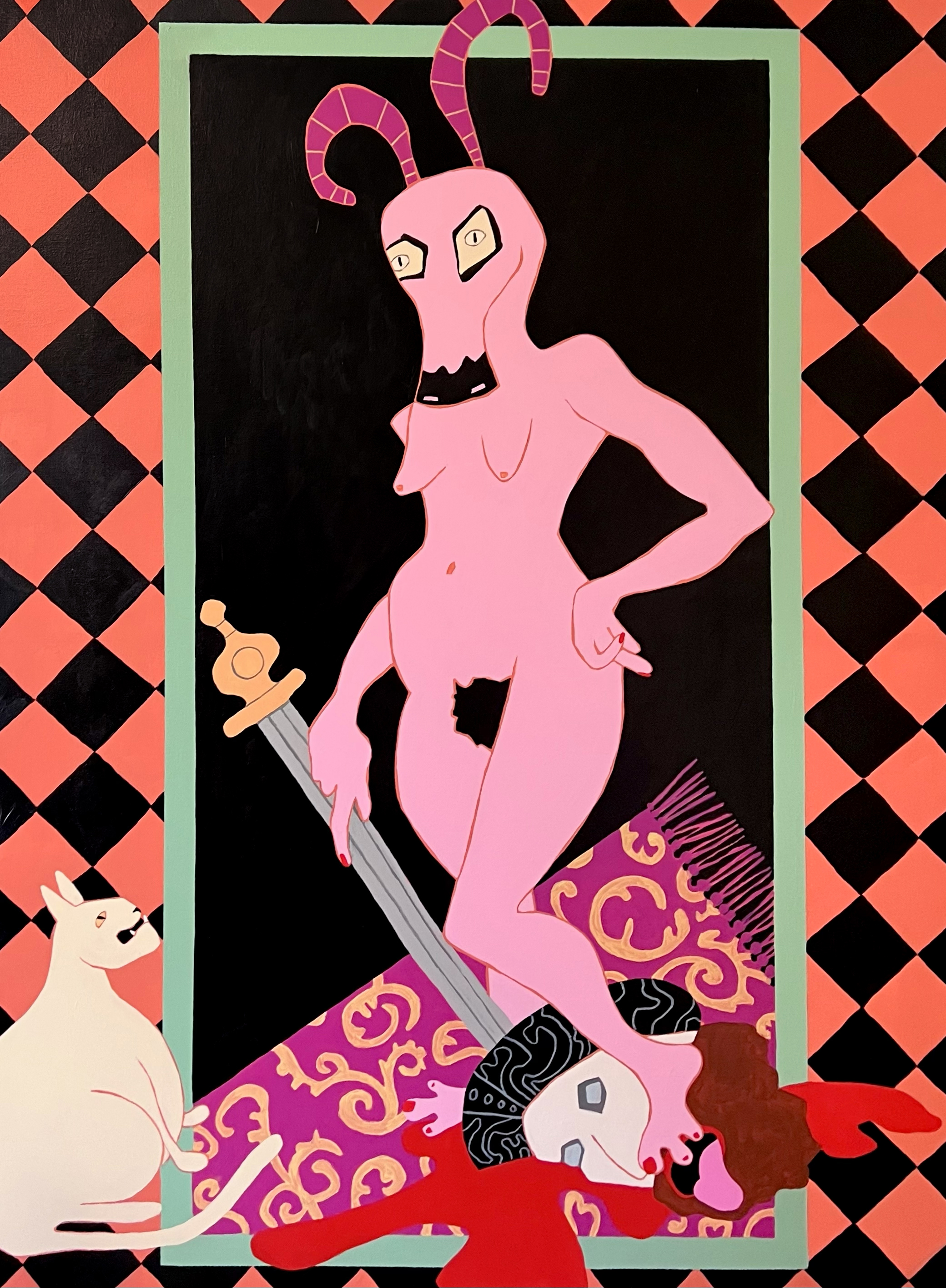
MG: Many scenes seem to move between pleasure, partying, the erotic, and at the same time something close to occultism, violence or even crime. How do you work that boundary between enjoyment and danger?
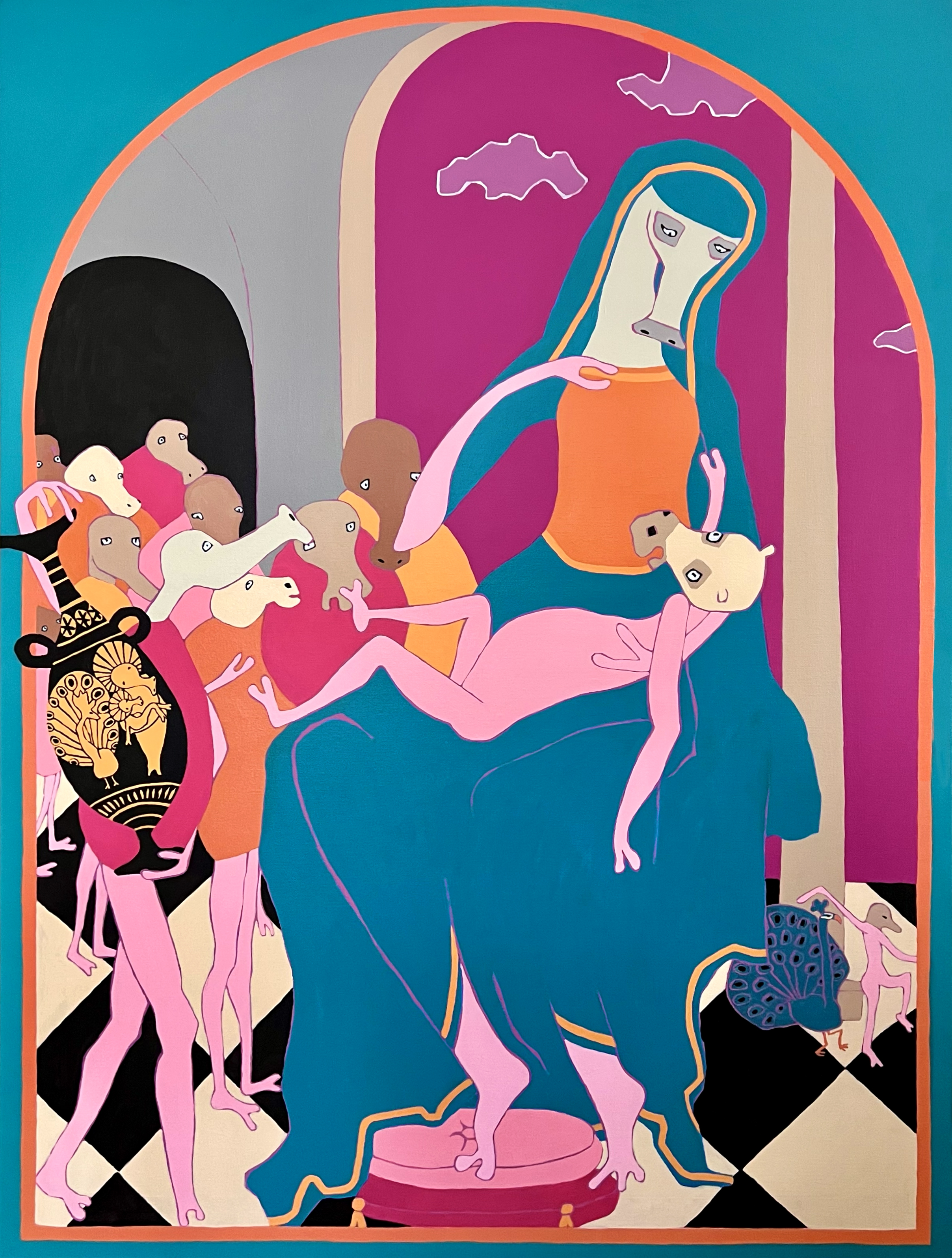
pmd: Humans are generally pleasure-seeking beings, but pleasure is often had at the expense of others, so I think these things exist simultaneously. Violence & superstition seep in and permeate society in subtle, sometimes unnoticed ways, so I try to insert that via background events such as arguments on tv, in paintings within the painting, or immortalized depictions on vases celebrating violent behaviours.
MG: Are you interested in the viewer feeling guilty for looking, as if they were witnessing something they should not be seeing?
pmd: No, I’m not interested in any kind of voyeuristic guilt. Although I do hope viewers see themselves in some of these characters and feel guilty for behaving in similar ways.
MG: Do you think of these scenes as rituals, as theatrical acts, as fragments of a longer, unseen film, or as frozen moments with no before or after?
pmd: I see the scenes in these paintings as shards from a larger, entangled world.
MG: When gestures or allusions to crime appear, do you draw on real news, cinematic imagery, personal experiences, or is everything built from fiction?
pmd: Snippets from contemporary life inevitably come into the work via the news, social media, et., albeit in a distorted and likely unrecognizable manner.
Colour, strident pink and distorted childhood
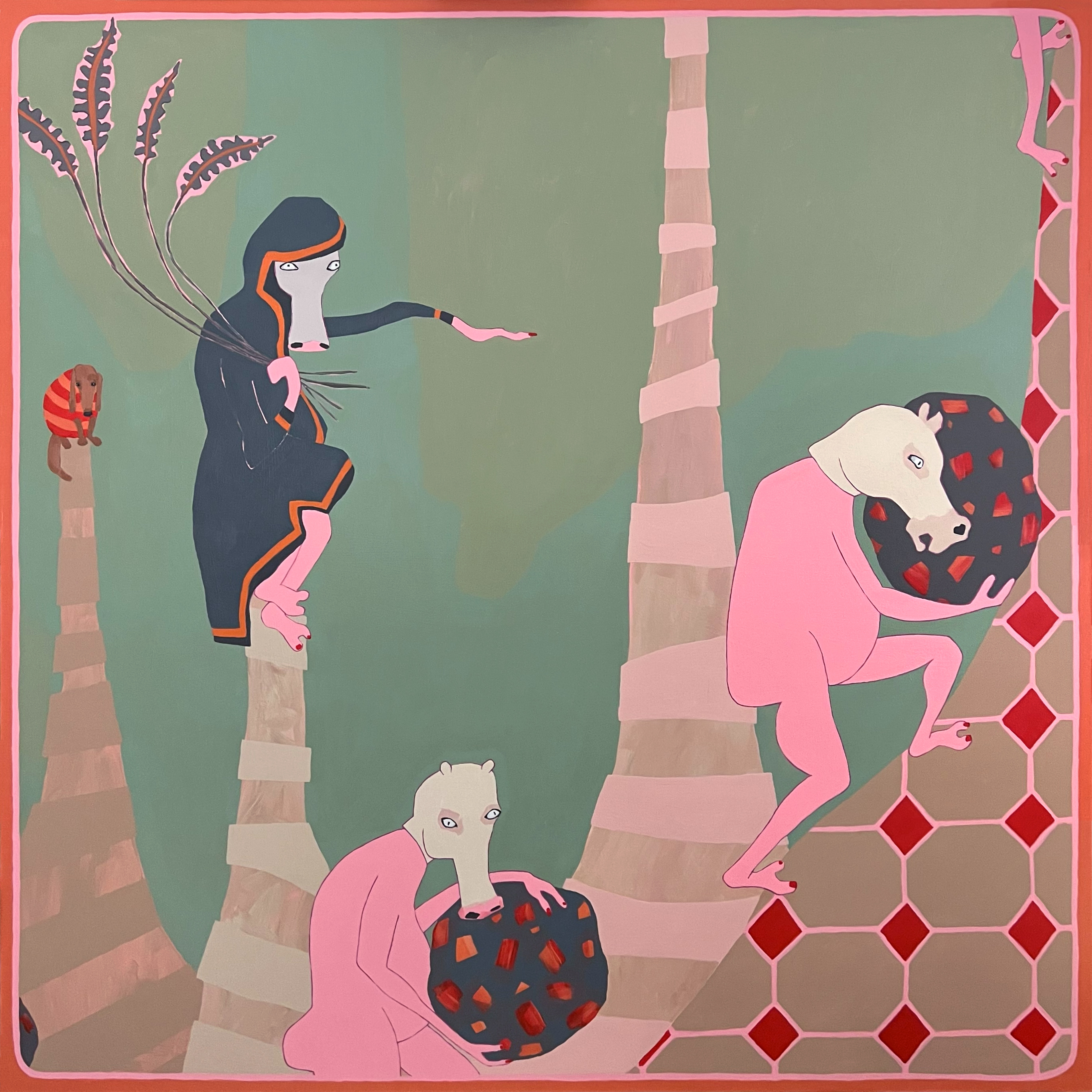
MG: Pink and strident colours recall childhood, what is friendly, sweet and comic, but when you look closely the scene becomes grotesque and incomprehensible. How did you arrive at such a specific palette?
pmd: I’m trying to create a universe that moves mercurially between sickly sweet and uncomfortably grotesque.
MG: Would you say that you work against the cultural meaning of pink, or rather that you exaggerate that meaning until it becomes unsettling?
pmd: I like to think I exaggerate and distort it until it becomes an unsettling something-other.
MG: What personal relationship do you have with the colour pink: childhood memories, objects, advertising, pop culture…?
pmd: There is something fascinatingly polarizing about pink. Growing up pink was very gendered, and as a farm kid, I didn’t have pink things. As an adult, pink seemed reserved for uber femmes. Pink flamingos were the epitome of kitsch. Then the Barbie movie came out and pink was everywhere. Now the pendulum is swinging back to where pink is tacky again. I find this fluctuation and polarizing cultural relationship to pink fascinating – what other colour do people have such strong feelings about?? This is fertile ground.
MG: How do you think about the balance between “cute” and disturbing, so that the work does not remain merely decorative but does not become overtly dark either?
pmd: I don’t try to resolve it, and I think that’s how it works. a clip from my artist statement sums this up a bit: …cute, faintly menacing beings nimbly traverse unsettling landscapes. In these spaces, cuteness does not point to comfort in a world full of danger, but rather “moves mercurially between familiarity and unfamiliarity, harmlessness & menace… & the human & the in-human (or non-human), without… even seeking a resolution of these tensions.” (Simon May, The Power of Cute, 29).
MG: Your work has been described as an elegant, refined kitsch. Do you recognize yourself in the word “kitsch”, or does it make you uncomfortable? What kind of kitsch interests you and which kind do you reject?
pmd: I find discussions about kitsch often end up talking about high vs low art, which are hierarchies I find a bit dated and boring. My work is garish and tacky and sickly sweet, so maybe it’s a bit kitsch, a bit camp? I thought it teetered too much towards the uncomfortable to truly occupy the kitsch realm, but if Yoshitomo Nara’s work can be described as kitsch, then maybe I need to rethink my definitions.
Text, humour and critique of the world
MG: In some works humour, the absurd, the scatological or even outright insult appear. How do you decide when it is necessary to introduce verbal language or visual jokes?
pmd: I think most of my work has jokes in some form or other (but maybe it’s only me that thinks they’re funny idk?)
MG: Do you think humour functions as a defence mechanism when dealing with issues such as violence, capitalism, mental health or the feeling of global collapse?
pmd: I think humor is a coping mechanism – it’s a laugh so you don’t cry sort of thing. But lately it’s probably more laugh and cry at the same time. Humor can also be disarming, allowing an unexpected segue into more challenging subject matter, making it an incredibly useful tool.
MG: What kind of laughter are you interested in provoking: uneasy laughter, liberating laughter, nervous laughter, silent inner laughter…?
pmd: I prefer uneasy, nervous, implicated laughter.
MG: When you work with references to popular culture, consumerism or social media, do you see yourself more as a chronicler, as a critic or as an accomplice?
pmd: I am possibly all of the above? The question reminds me of how Warhol brilliantly and simultaneously occupied these roles, highlighting yet celebrating complicity in consumer culture, and reminding us we are not standing outside looking in (even if maybe we want to be).
Working process and subjective experience
MG: What is a typical working day like for you when you are immersed in a new series with the horse and the dog as its core?
pmd: A typical painting starts with notes & research, then a drawing, which gets transferred to a panel, that I work on until it’s completely finished (resolved or abandoned). Then repeat.
MG: What role do chance, error and clumsiness play in your process? Do you leave those traces visible or do you polish them away until they disappear?
pmd: Clumsiness actually plays a big role in my work. I do a lot of colour testing on my phone in the photos app and try to retain some of the awkward gestures from the phone finger scribbles. These forms often feel fresh and awkward in a way that I have difficulty achieving intentionally, so I work back from them.
MG: How does your emotional state influence the pieces? Do you allow a work to remain “too dark” if it coincides with a difficult personal moment, or do you try to modulate that?
pmd: I am not really worried about ‘too dark’, but sometimes I find the work is a bit crap if it’s too emotional.
MG: Do you have any rituals before working (music, reading, films, walks) that help you get into the right tone for this universe that is both hedonistic and sinister?
pmd: No rituals per se (I am naturally hedonistic & sinister lol) – just music & solitude. And hopefully the cat.
Reception, misunderstandings and audience
MG: What is most often misinterpreted in your work when people see it for the first time?
pmd: I think initially some people categorize my work as superficial or silly. I’m not sure if that’s a misinterpretation or just an interpretation though?
MG: Are you interested in maintaining a certain degree of incomprehension or mystery, or do you hope that, over time, the viewer can “read” the internal keys of your universe?
pmd: I don’t want my work to be didactic, but I hope viewers will pick up on references and character dynamics. I realize the logic of these spaces that is obvious to me is not always apparent to viewers, so the titles are keys of sorts, as are the repetition of characters.
MG: Has any comment from collectors, curators or people on social media ever made you see your work in a completely new way, for better or worse?
pmd: I received a bad review on an early video piece (Pollination Proposition), saying that the topic of declining bee populations was too serious of an issue to be addressed in such an absurd & ridiculous manner, and that it was disrespectful (to bees I think??). Maybe she was right, but it made me realize that was my strategy – humor is a very disarming, powerful tool for navigating difficult topics, and not everyone will be receptive to work that doesn’t look ‘serious’ enough to have a thoughtful or critical angle, but I kind of like that. and suddenly people were writing about the issue of declining bee populations, so that seemed to be the point anyway??
MG: How do you deal with the fact that a part of your work, with its pink and eye‑catching aesthetics, can be consumed very superficially on Instagram, while you are working with much denser layers of meaning?
pmd: I think good work functions on multiple levels. Ideally everyone would deep dive into people’s artworks, but they don’t always. I like the idea that my work can appeal to some viewers on a more superficial level, but also there are other layers there for anyone who cares to look.
Future of the horse, the dog and the Pink Milk Drink universe
MG: Can you imagine this horse‑being and this dog in ten years’ time? Do you see them evolving, ageing, disappearing, or turning into something completely different?
pmd: I let my mind go where it needs to go, so they may still be around in some form or another, but I suspect they will be quite distorted by then.
MG: If you had to summarize in a single sentence what this hedonistic horse is trying to do in a grotesque, pink world, what would it be?
pmd: The horse is merely trying to hold up a broken mirror for us.

