‘plant some fukin plants already’ is a series of 4 custom seed packs (rife w profanity cause why tf not) designed to encourage support of our little flying friends w the planting of pollinator-friendly plants. This project aims to centre the needs of pollinators first. Rather than selecting plants solely on what we think is pretty or what matches our couch, maybe we can be altrustic af and try selecting plants that are beneficial to native bees & other pollinators whose habitat n food sources have been vastly diminished by our sprawling urbanscapes & mono-cropping practices (boo lawns).
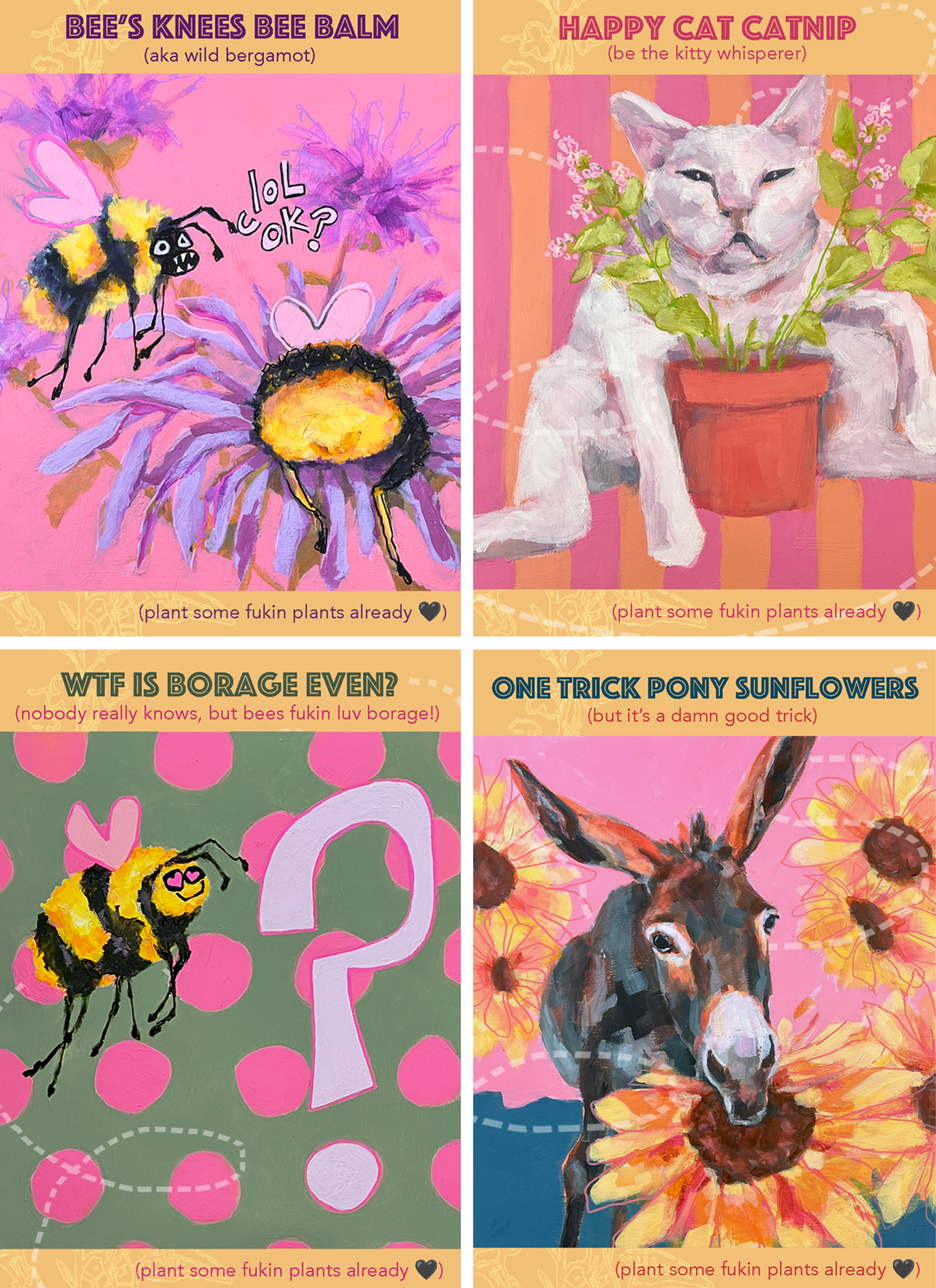
Pollinators need some help rn & one of the easiest ways to lend a hand is planting food for them in whatever space u have. Loss of habitat is one of the biggest factor impacting pollinators, especially in urban & suburban environments, so even a few pots of pollinator-friendly plants on ur balcony or deck can help support these crucial creatures. 🐝 🖤 these seed packs r cute af so grab some for yerself or as a gift n getting everybody planting some fukin plants already! 🐝 🖤

these four plants have been selected not b/c they are the best or only plants that support pollinators (there many lists of what to grow), but these selections all provide ample pollen & nectar that is accessible to a range of pollinators, have long blooming seasons, are either native wildflowers (sunflowers & bee balm) or considered non-invasive species for north america (borage & catnip), & 3 out of 4 are appropriate for growing in almost all regions in Canada & US (including northern regions, but not over winter cause fuk). the exception being bee balm/wild bergamot which is a native plant, but to southern regions in Canada & from the midwest east in the states. but pollinators fukin luv it, so here we are. also the internets says Borage grows best in the southern half of Canada, but borage seems to thrive in the Yukon (next to Alaska) so why tf not give it a go.
seeds will come with a fun QR code to open up an Augmented Reality (AR) pollinator garden yay 🖤 jus scan the QR code w ur phone camera & click the link & an AR garden will open up (it has a bee that talks a lot (he’s kind of annoying actually but he was there when i got there so i dunno) & of course blissed out bees & purdy flowers)
plant deets 🐝 🖤
bee balm: everybody (like everybody) seriously luvs bee balm, from all kinds of bees to moths to hummingbirds (hummingbirds fight over these when they bloom wtf??). bee balm is also good for pollinator nesting material. blooms mid summer & is real purdy u won’t be disappointed.
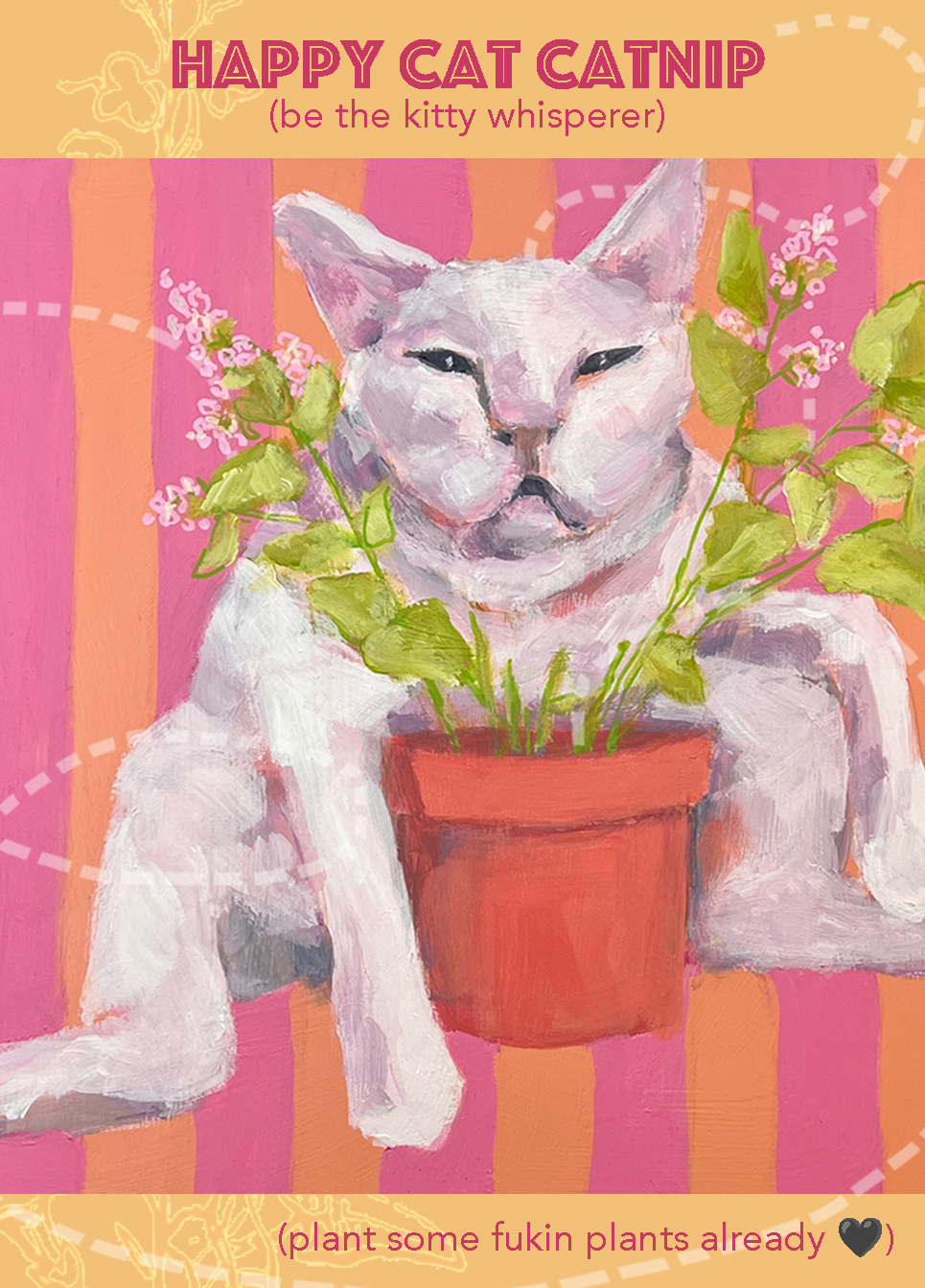
catnip: if u treat it right, catnip will bloom for many months from spring to summer, so it’s good for our bee friends. grow a big ol pot of it cause the flowers r kinda small n we want to give lots of food to the flying ones. beware cause cats also like it as much as bees, so u’ve been warned. also great to dry for ur furry cat friends (be the kitty whisperer).
Borage: nobody knows what Borage is really, but it apparently has long bloom periods (can also stagger planting), Borage secretes nectar all day & is important as it continues to do so even into cold weather as bees scurry to gather food for winter. Borage is mostly for bees (apparently butterflies don’t give a fuk about it) & has a high pollen content. both flowers & leaves r edible n look kinda fuzzy n real cute so there’s something for u too.
sunflowers: just the epitome of summer for hoomans, w high sugar concentrations in nectar, so are excellent pollinator-friendly plants too. Sunflowers are native to north america & used to be called Compositae, which gives a clue to the fact that they are actually not one large flower but rather a tightly grouped cluster (or composite) of tiny flowers, w the outer ring of flowers having just one petal. “A sunflower may have a thousand or more individual florets in each flower head, a convenient buffet for bee”, describes Paige Embry. many kinds of native bees as well as other pollinators jus luv sunflowers, so be altruistic af & give them a lil buffet in the sky.
so jus plant some fukin plants already bb 🐝 🖤

why Pollinator Partnership Canada is important:
Pollinator Partnership’s mission is to promote the health of pollinators, critical to food and ecosystems, through conservation, education, and research. They work with farmers, gardeners, land managers, scientists, and industry to develop tools and programs that help keep pollinators safe from pesticides, habitat loss, climate change, and other threats. Their programming & outreach focuses on science-based research, inclusion of diverse perspectives, and implementation of incremental & sustainable initiatives to promote sustainable change in support of pollinators. For more info & resources visit https://www.pollinator.org/

resources 🐝 🖤
Eric Lee-Mäder, Jarrod Fowler, Jillian Vento & Jennifer Hopwood. (2016). 100 Plants to Feed the Bees: Provide a Healthy Habitat to Help Pollinators Thrive. The Xerces Society for Invertebrate Conservation, Storey Publishing.
Paige Embry. (2018). Our Native Bees: North America’s Endangered Pollinators and the Fight to Save Them. Timber Press.
Pollinator Partnership Canada. (2024, March 5). Ecoregional Planting Guides. https://pollinatorpartnership.ca/en/ecoregional-planting-guides
Morandin, Lora. (2024, February, 6). Pollinator Steward Certification: Introduction to Pollinators. Pollinator Partnership Canada.
pmd 2025
 pink milk drink